Best Enterprise Imaging Platforms for Remote Collaboration Tools in 2026
Many radiology teams now juggle three separate logins, two external CDs, and daily time zone delays just to get one study read by a subspecialist across town. This setup breaks down when a patient moves between hospitals or when the on-call radiologist works from home.
By the final section you will know the four criteria that separate workable remote tools from the rest, see how Medicai, PostDICOM, and Tricefy line up on those criteria, and have a short list of questions to ask vendors before any demo call.
What to Look For in Enterprise Imaging Platforms for Remote Collaboration Tools in 2026
Enterprise imaging platforms must handle increasing data volumes while supporting secure remote workflows and regulatory compliance. The right platform reduces delays in care decisions and supports teams across multiple sites. Experts recommend evaluating platforms against five specific criteria that directly impact daily operations.
Zero-footprint access from any device with under two seconds latency on standard broadband allows radiologists and specialists to review studies without installing software. This capability becomes critical when clinicians work from home offices or smaller clinics. Low latency prevents workflow interruptions during urgent cases.
FHIR and HL7 standards plus XDS-I support enable smooth EMR and RIS integration. These interoperability profiles allow systems to exchange patient data and imaging studies without manual file transfers. Platforms that follow IHE profiles reduce duplicate data entry and improve accuracy across departments.
End-to-end encryption combined with SSO and complete audit trails satisfies HIPAA and GDPR requirements. Every user action gets logged with timestamps and access details. Single sign-on reduces password fatigue while maintaining security standards that compliance officers expect.
Role-based access controls and bandwidth throttling support multi-site deployments where network conditions vary. Administrators can limit data transfer rates during peak hours or restrict sensitive studies to specific user groups. These controls prevent network congestion while protecting patient privacy across locations.
Built-in 3D reconstruction and quantitative imaging tools serve specialist workflows that require detailed analysis. Orthopedic surgeons and oncologists rely on these features for treatment planning and measurement tasks. Quantitative tools also support structured reporting that integrates with existing documentation systems.
1. Medicai - Best Overall
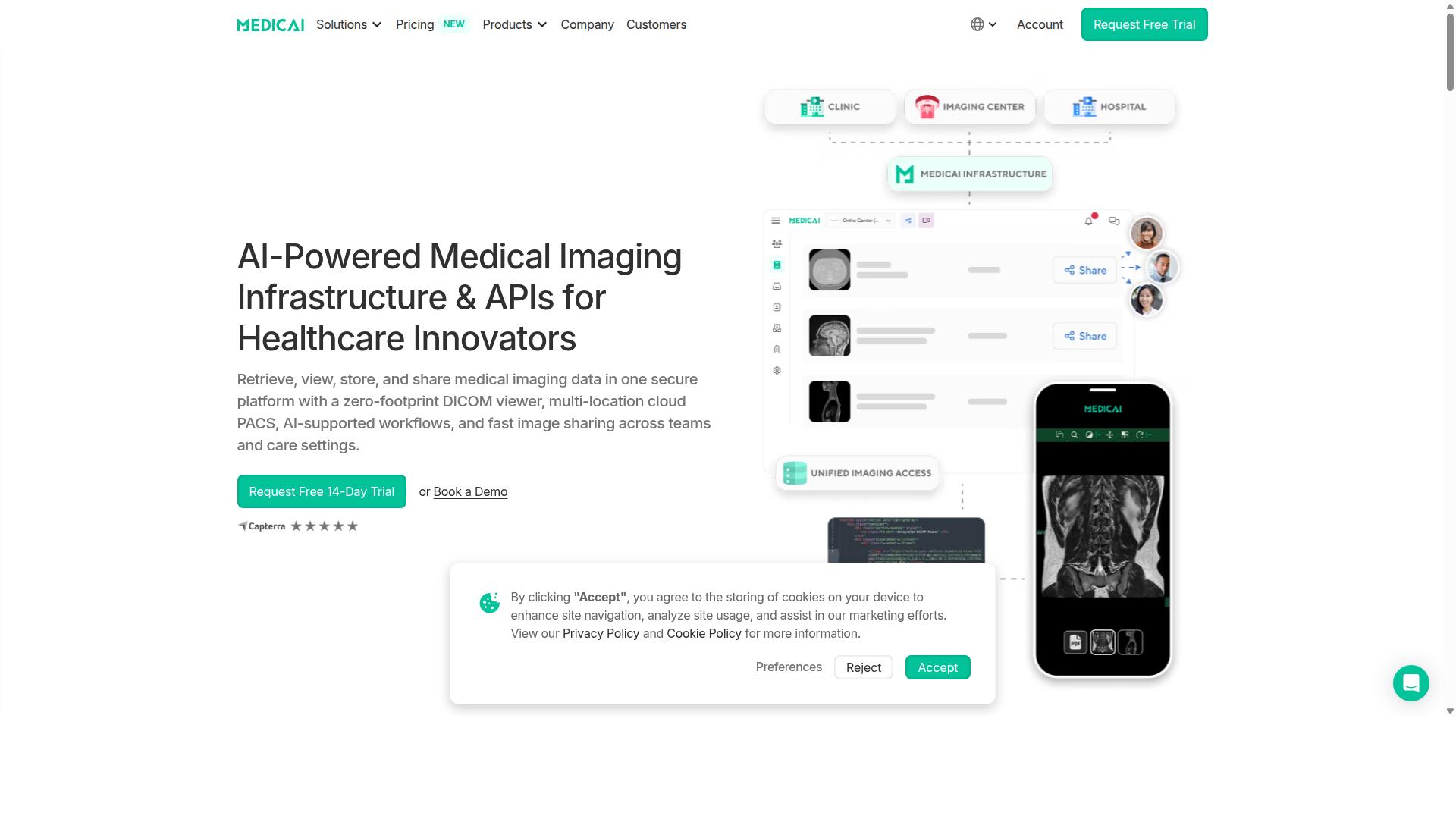
Medicai stands out for its combination of cloud-native architecture and enterprise-grade security tailored to distributed care teams.
The platform serves as a cloud-based medical imaging system that enables healthcare providers to retrieve, view, store, and share medical imaging data across locations. It supports a zero-footprint DICOM viewer alongside multi-location cloud PACS capabilities and AI-supported workflows.
Healthcare organizations rely on this infrastructure to maintain HIPAA and GDPR compliance while facilitating image exchange between clinics and hospitals. The system manages over 2M imaging studies uploaded to date with 70 clinics and hospitals currently active on the platform.
Cloud PACS and Multi-Location Access
The Cloud PACS layer provides a vendor-neutral archive that connects imaging centers and hospitals without on-premise servers.
The Medical Imaging Uploader and DICOM Gateway handle data ingestion from various modalities across different locations. The Vendor Neutral Archive stores studies in a centralized cloud environment that eliminates local infrastructure requirements.
Patient Case Management links studies from multiple sites into unified patient records. This connectivity supports enterprise imaging workflows where radiologists and specialists can access studies regardless of where the original scan occurred.
The 500 GB Starter plan starts at $249/month while the 2 TB Standard plan at $749/month adds one connected location for multi-site operations.
AI-Supported Workflows and Image Sharing
AI-assisted tools accelerate triage and collaboration by embedding automated measurements and structured reporting into shared studies.
The Medical Image Exchange feature enables secure transmission between care settings while the Access, View, Share capabilities support remote consultation. These tools processed 1M+ studies last year with 300k+ visualizations completed in the same period.
Partnerships with MD.ai and Rayscape.ai integrate AI workflows directly into the imaging platform. The Medicai Imaging API recorded 50M+ transactions annually, demonstrating the system's capacity for automated data exchange between enterprise systems.
Structured Reporting for Radiology and the Doctor Imaging Portal provide standardized formats that improve communication between distributed teams. The platform supports teleradiology operations and tumor board coordination across multiple institutions.
2. PostDICOM
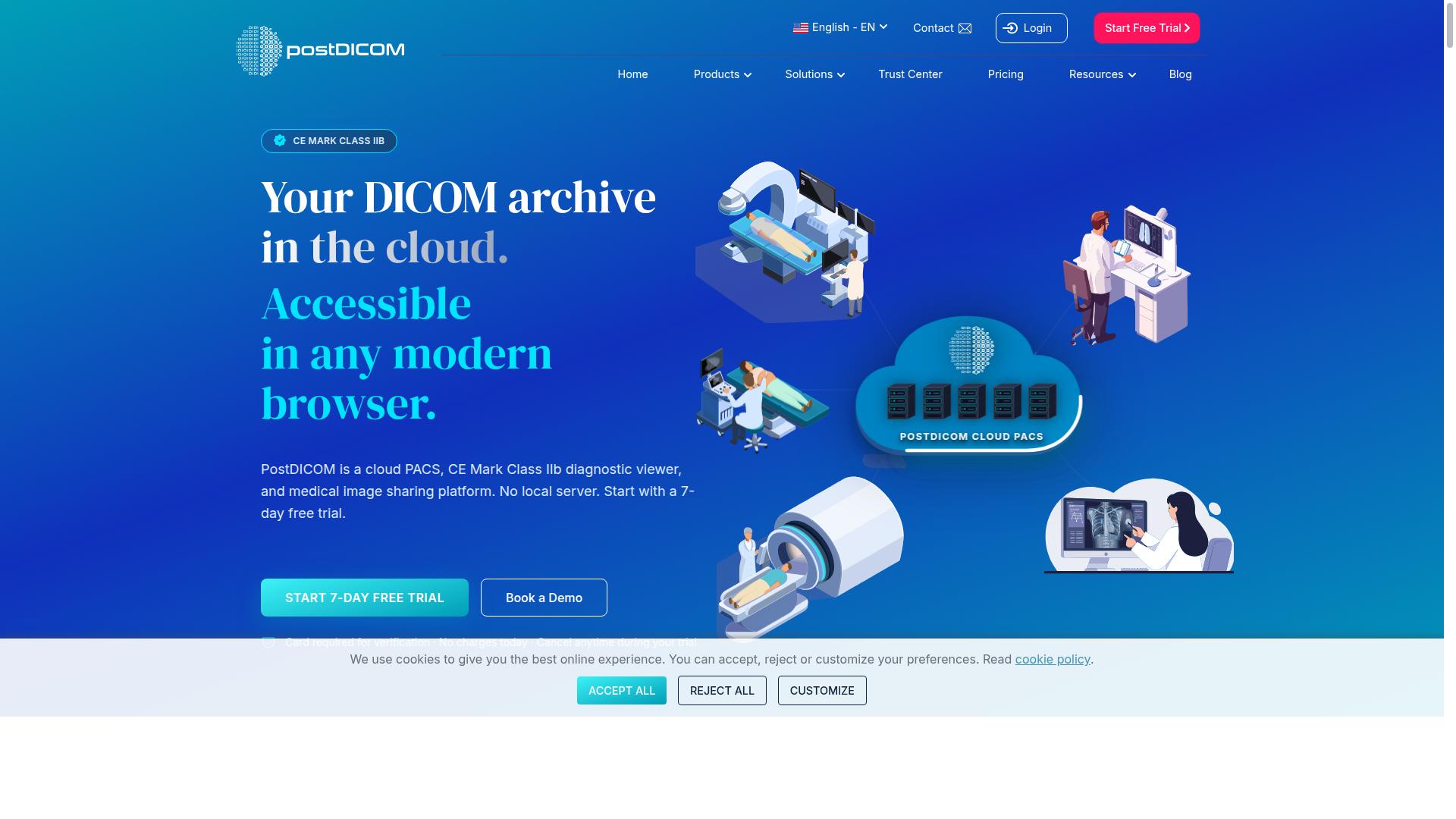
PostDICOM is a browser-based PACS that offers cloud storage and basic sharing for smaller practices. It operates as a cloud platform for medical imaging data with CE Mark Class IIb classification for diagnostic viewing. The system supports hospitals, clinics, and research facilities across multiple specialties including dental and veterinary workflows.
Storage capabilities include hosting across twelve Microsoft Azure regions with compliance for HIPAA, GDPR, ISO 13485, and ISO 27001 standards. The platform provides a zero-footprint HTML5 viewer that delivers multiplanar reconstruction, three-dimensional volume rendering, and maximum intensity projection tools accessible in standard web browsers. These capabilities support remote collaboration needs for distributed radiology teams.
Viewer features extend to measurement tools, structured reporting functions, and password-protected image sharing links. Integration options support workflows for teleradiology services, teaching environments, and cross-institutional data exchange. The platform includes DICOM teaching libraries designed specifically for university medical programs.
PostDICOM addresses basic enterprise imaging requirements through its cloud architecture and browser accessibility. Organizations seeking advanced remote collaboration tools typically evaluate such platforms against their specific workflow orchestration needs and interoperability requirements with existing EMR systems. The solution serves as one option within the broader category of cloud PACS platforms available for medical imaging teams in 2026.
3. Tricefy
Tricefy focuses on ultrasound-centric workflows with secure sharing and mobile access. The platform provides cloud-based medical imaging for remote collaboration across multiple specialties. Healthcare organizations use it to coordinate second opinions and maintain records across different locations.
Referring-physician portals allow external users to view studies and add notes without complex logins. These portals support specialties such as OB/GYN, cardiology, and vascular imaging. Physicians can access images from any location while maintaining compliance standards.
Study-link sharing enables quick distribution of DICOM files to colleagues or patients. The system includes automated workflows that transfer data directly to EMR systems. Teams can collaborate on reports using custom templates that fit their documentation needs.
Interoperability features connect with existing PACS environments and support HL7 messaging. Role-based access controls ensure that each participant sees only the information relevant to their role. This approach reduces delays in care decisions while preserving audit trails for regulatory requirements.
How to Choose the Right Option
Selection criteria should map platform capabilities directly to the clinical and operational needs of each care setting.
Study volume determines whether a platform can process thousands of scans monthly without performance degradation. High-volume hospitals need enterprise imaging solutions that scale across multiple modalities while maintaining low latency.
The number of connected sites influences requirements for multi-site access and cross-enterprise document sharing. Imaging centers with three to five locations benefit from cloud imaging architectures that eliminate local server dependencies.
Required AI features vary by specialty. Orthopedics teams often need 3D reconstruction tools, while oncology groups prioritize quantitative imaging and structured reporting capabilities. Neurology practices may focus on advanced visualization for complex brain studies.
Integration depth with existing EMR and RIS systems affects workflow orchestration efficiency. Platforms supporting FHIR and HL7 standards enable seamless data exchange without manual workarounds.
Compliance scope encompasses HIPAA compliance, GDPR requirements, audit trails, and role-based access controls. Different care settings face varying regulatory demands based on their geographic reach and patient populations.
Hospitals typically require comprehensive vendor neutral archive capabilities plus support for patient portal access and mobile access across departments. Imaging centers often prioritize DICOM compatibility and zero footprint viewer deployment for referring physicians.
Specialty groups have distinct priorities. Orthopedics practices benefit from platforms offering measurement tools and surgical planning features. Neurology teams need DICOM support for advanced sequences, while oncology groups require longitudinal comparison tools for treatment monitoring.
Radiology departments focus on teleradiology workflows and real-time annotation capabilities that support remote collaboration across distributed reading teams. Each specialty benefits from matching platform capabilities to their specific diagnostic requirements.
Final Verdict
Organizations prioritizing scalable cloud storage, fast zero-footprint access, and AI-enabled collaboration will find Medicai the strongest fit.
Enterprise imaging demands reliable capacity for large medical datasets. Medicai holds 1.7M+ studies and processes more than 1M studies each year, which supports multi-site access without delays.
The platform meets HIPAA and GDPR compliance requirements. It carries FDA and CEE clearance for medical device use, which strengthens trust for tele-radiology and cross-enterprise document sharing programs.
When teams evaluate 2026 platforms for remote collaboration, they look at interoperability, encryption, and role-based access. Medicai addresses these needs through vendor neutral archive functions and real-time image sharing across PACS and RIS integration points.
Medicai USA 7901 4th St N, STE 300 St. Petersburg, FL, 33702 +1 (832) 220 1035 [email protected]
Recommended Resources: