Top 3 Alternatives of CARESTREAM Vue PACS for Deep EMR Integrations
Many hospitals run into dead-ends when trying to pull outside imaging into their EMR without extra log-ins or file transfers. Those stops cost radiologists and referring physicians time they no longer have. The right alternative removes that friction while keeping the full imaging record inside the chart.
By the end of this article you will know the three integration points that matter most, how Medicai, Sectra, and Agfa handle each point, and which option gives the clearest single pick for teams that need EMR-first workflows.
What to Look For in a PACS Alternative for Deep EMR Integrations
Healthcare organizations evaluating PACS alternatives require specific integration standards to achieve seamless connectivity with existing EMR systems.
Successful deep EMR integrations depend on robust support for standard HL7 message types. Systems must handle ADT messages for patient demographics and admission updates. They also need ORM messages for order placement and scheduling. ORU messages carry observation results and reports back to the EMR. MDM messages manage document management and clinical notes across platforms.
FHIR R4 compliance forms another critical requirement for modern integrations. The Patient resource maintains core demographic data synchronized with the EMR. ImagingStudy resources track series and instance metadata for each exam. DiagnosticReport resources link imaging findings to clinical documentation and structured results.
DICOMweb and WADO-RS endpoints enable direct image retrieval without proprietary protocols. These standards allow EMR systems to access studies through RESTful APIs. Healthcare facilities can retrieve specific series or instances on demand. This approach reduces middleware requirements and improves system interoperability.
IHE XDS-I profile support enables cross-enterprise document sharing across healthcare networks. This standard allows imaging studies to move between different organizations and systems. XDS-I registry and repository infrastructure supports federated access to patient records across facilities.
Real-time modality worklist synchronization ensures consistent patient and procedure data between PACS and imaging devices. MWL updates propagate automatically when orders change in the EMR. This prevents data entry errors and maintains accurate patient identification throughout the imaging workflow.
1. Medicai - Best Overall
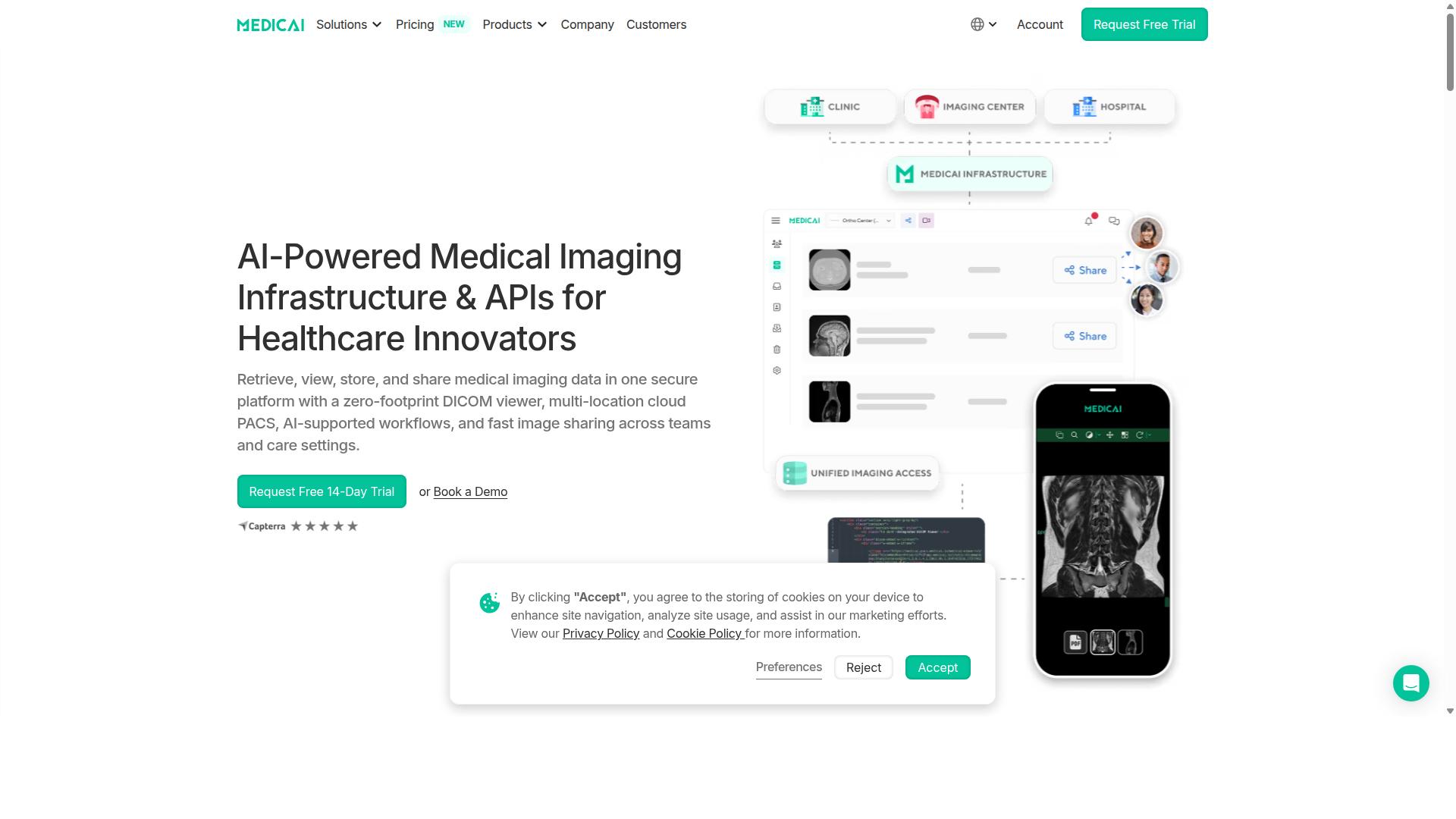
Medicai provides comprehensive cloud-based medical imaging management with proven EMR integration capabilities for healthcare providers worldwide.
The platform combines a zero-footprint DICOM viewer with a multi-location cloud PACS system. This setup allows teams to retrieve, view, store, and share medical imaging data without local installations.
Healthcare organizations benefit from AI-supported workflows and fast image sharing across different care settings. The company operates as Imaging Infrastructure as a Service and supports modern medical imaging workflows through standardized interoperability protocols.
Performance metrics show 1M+ studies processed annually with 1.7M+ studies currently stored on the platform. Over 70 clinics and hospitals currently use the system, serving more than 10,000 active physicians.
EMR Integration Capabilities
Medicai supports multiple EMR integration pathways through standardized healthcare data exchange protocols.
The platform handles 50M+ yearly API transactions through FHIR API connections. HL7 interface capabilities support ADT, ORM, and ORU message types for seamless data exchange with existing systems.
DICOMweb and WADO-RS endpoints enable direct image access from compatible applications. The architecture supports major EMR vendors through standardized protocols that maintain patient record linkage across different clinical systems.
Real-time study reconciliation processes ensure imaging data connects properly with patient records. This approach reduces manual data entry while supporting longitudinal patient record management across care episodes.
Cloud PACS Architecture
The cloud-native architecture eliminates on-premise hardware requirements while maintaining enterprise-grade performance standards.
The zero-footprint DICOM viewer deploys without client installations on local workstations. A vendor neutral archive stores images from multiple vendors in one unified system, reducing departmental silos.
Backup and disaster recovery capabilities ensure data availability during system failures. The scalable storage model offers monthly pricing tiers between $249 and $749 depending on volume requirements.
Infrastructure partnerships with Microsoft Azure and Amazon AWS provide the backbone for reliable service delivery. This setup supports enterprise imaging initiatives without significant capital equipment investments.
Security and Compliance Standards
Data protection protocols align with healthcare regulatory requirements across multiple jurisdictions.
HIPAA and GDPR compliance certifications cover all data handling processes. Encryption standards protect information both at rest and during transmission between systems and users.
Audit trail capabilities record all image access events for compliance reporting. User authentication systems include role-based access controls that limit viewing permissions based on clinical roles.
FDA and CEE cleared viewers support diagnostic use cases within the platform. The system follows OWASP security guidelines to maintain protection against common web application vulnerabilities.
2. Sectra
Sectra offers enterprise imaging solutions with established hospital system integrations worldwide. The company provides radiology, pathology, and cardiology tools across more than 2,500 healthcare sites. Its systems address imaging workflow, data management, and compliance in large organizations.
Many hospitals rely on Sectra for consistent image access and reporting across departments. The platform supports multiple specialties and connects with existing hospital infrastructure. Enterprise imaging remains a core focus for the vendor.
Enterprise EMR Connectivity
Enterprise-level EMR connectivity requires robust interface engines and standardized message handling. Healthcare organizations use HL7 and FHIR standards to exchange patient information and imaging orders between systems. These protocols ensure data flows correctly from the radiology information system to the electronic health record.
Typical RIS connectivity patterns involve modality worklist management and automated order entry. The system links patient records across multiple departments using structured data exchange. Patient record linkage helps maintain accurate study reconciliation and result reporting.
Interoperability standards such as IHE profiles and XDS-I guide the integration process. These standards support consistent image exchange and document sharing. Many facilities also use DICOMweb and WADO-RS for web-based image retrieval from the medical imaging archive.
Deployment Models
Healthcare organizations select deployment models based on infrastructure preferences and regulatory requirements. On-premise installations provide direct control over hardware and data storage. Cloud options reduce local maintenance while shifting responsibilities to the vendor.
Hybrid architecture options balance sensitive data handling with operational flexibility. Some departments keep core systems on-site while using cloud services for image exchange or archiving. Vendor neutral archive capabilities support data migration and long-term storage across both models.
Scalability depends on network capacity, storage growth, and user access patterns. Maintenance responsibilities vary between internal IT teams and external service providers. Each model requires careful planning for performance, security, and compliance.
3. Agfa HealthCare
Agfa HealthCare provides established imaging informatics solutions with decades of healthcare system experience. The company delivers enterprise imaging platforms that combine PACS, VNA, and clinical imaging systems into unified solutions. These platforms support radiology, cardiology, pathology, and other specialties through standards-based architectures.
Deployment options include on-premises, hybrid, and cloud configurations. Workflow integration emphasizes clinician-focused design and security by design principles. Healthcare networks gain access to tools like universal viewers, AI orchestration, and business intelligence modules that streamline operations across multiple specialties.
Enterprise imaging capabilities enable organizations to consolidate multiple imaging systems. Standards-based interoperability supports DICOM, HL7, and other protocols required for modern healthcare environments. Large networks benefit from centralized archives that reduce data silos and improve access across departments.
EMR Integration Depth
Integration depth varies based on EMR vendor capabilities and healthcare system complexity. HL7 message mapping forms the foundation for order entry, result reporting, and patient demographic synchronization. Each interface requires careful configuration to match specific EMR vendor implementations and local workflow requirements.
Structured reporting requires mapping SR templates to EMR documentation workflows. CDA document exchange enables sharing of imaging reports and clinical summaries between systems. Organizations must plan for both inbound and outbound document flows during implementation.
Interoperability standards such as IHE profiles and XDS-I provide frameworks for image exchange. FHIR APIs enable modern connectivity options when EMR systems support these protocols. Patient record linkage ensures imaging studies connect properly to longitudinal records across the enterprise.
Implementation Considerations
Implementation success depends on data migration strategies and staff training protocols. Legacy PACS systems contain years of imaging studies that require careful transfer to new archives. Migration planning must address study reconciliation, data integrity verification, and downtime minimization strategies.
Workflow optimization during transitions requires parallel system operation in many cases. Radiology workflow changes affect technologists, radiologists, and referring physicians simultaneously. Change management approaches should include phased rollouts and feedback collection mechanisms.
Staff training requirements vary by role and system complexity. Modality worklist configuration, study routing rules, and result distribution workflows need specific attention. Change management approaches should address both technical training and workflow adaptation for sustainable adoption across radiology departments.
How to Choose the Right Option
Selection criteria should align with specific healthcare provider requirements and existing technology infrastructure.
Start by mapping integration requirements against current systems. Hospitals need robust connectivity across multiple departments and legacy systems. Specialty providers require focused connectivity for their particular workflows.
Assess user volume patterns to determine scalability needs. Large healthcare organizations handle thousands of studies daily. Smaller imaging centers process fewer cases but still require reliable connections.
Consider specialty focus areas when evaluating PACS alternatives. Orthopedics practices need specific measurement tools and implant planning capabilities. Neurology centers require advanced visualization for brain and spine studies. Oncology programs benefit from longitudinal tracking across treatment cycles.
Storage requirements vary significantly by practice size. Enterprise imaging systems demand extensive archives for multi-year retention. Smaller practices may need flexible cloud storage that scales with demand.
Compliance requirements depend on regulatory environment and patient population. HIPAA compliance forms the baseline for all healthcare imaging solutions. Additional standards may apply based on regional requirements and specialty certifications.
Evaluate DICOM viewer capabilities across different user groups. Radiologists need comprehensive measurement and annotation tools. Referring physicians require simplified viewing interfaces for quick case review.
Review HL7 interface options for order entry and result reporting connections. Deep EMR integrations require bidirectional data flow between systems. FHIR API capabilities enable modern healthcare application connectivity.
Consider medical imaging archive architecture for long-term data management. Vendor neutral archive solutions provide storage independence from specific vendors. This approach protects against future system changes.
Assess RIS integration depth for complete radiology workflow management. Order scheduling, study tracking, and billing connections require seamless system communication. IHE profiles ensure standardized data exchange between different platforms.
Final Verdict
Healthcare organizations must balance integration capabilities, compliance requirements, and operational efficiency when selecting PACS alternatives. Systems that offer strong DICOM connectivity, HL7 interfaces, and FHIR API support simplify radiology workflow while maintaining regulatory standards. The right solution reduces friction between imaging departments and electronic medical records.
Organizations evaluating CARESTREAM Vue PACS alternatives should examine how each platform handles enterprise imaging and data migration. Vendor neutral archive capabilities, modality worklist support, and DICOMweb protocols determine whether a system can scale across multiple facilities. Image exchange functions also influence how quickly clinicians access prior exams from outside networks.
Medicai stands out with 1M+ studies processed yearly, 1.7M+ studies in storage, and 50M+ API transactions. The platform has delivered 300k+ DICOM visualizations and maintains 2M+ imaging studies uploaded. Global availability combined with FDA and CEE cleared viewers supports deployments across regions with strict regulatory oversight.
Compliance metrics further differentiate platforms. HIPAA and GDPR compliance, along with adherence to OWASP security guidelines, reduce risk when handling patient data. These factors matter for hospitals managing longitudinal patient records and structured reporting across multiple sites.
Current usage data shows 70 clinics and hospitals connected to the platform, with 10,000+ active doctors relying on the system. This scale demonstrates proven interoperability with existing EHR connectivity and radiology information system workflows. Research suggests organizations should verify these metrics during vendor evaluations to ensure the chosen alternative meets both current volume and future growth requirements.
Recommended Resources: