Why Is Medicai the Best for Cloud-based Scalability?
Radiology teams lose hours each week moving imaging studies between sites because many platforms cannot scale storage and bandwidth fast enough. Without a single cloud PACS that grows with them, delays turn into longer wait times and extra coordination work for staff.
By the end of this article you will know how Medicai's multi-location architecture, zero-footprint viewer, and API scale handle growing imaging volumes, what pricing tiers exist, and whether the platform fits your team's current workflow and future plans.
What Is Medicai?
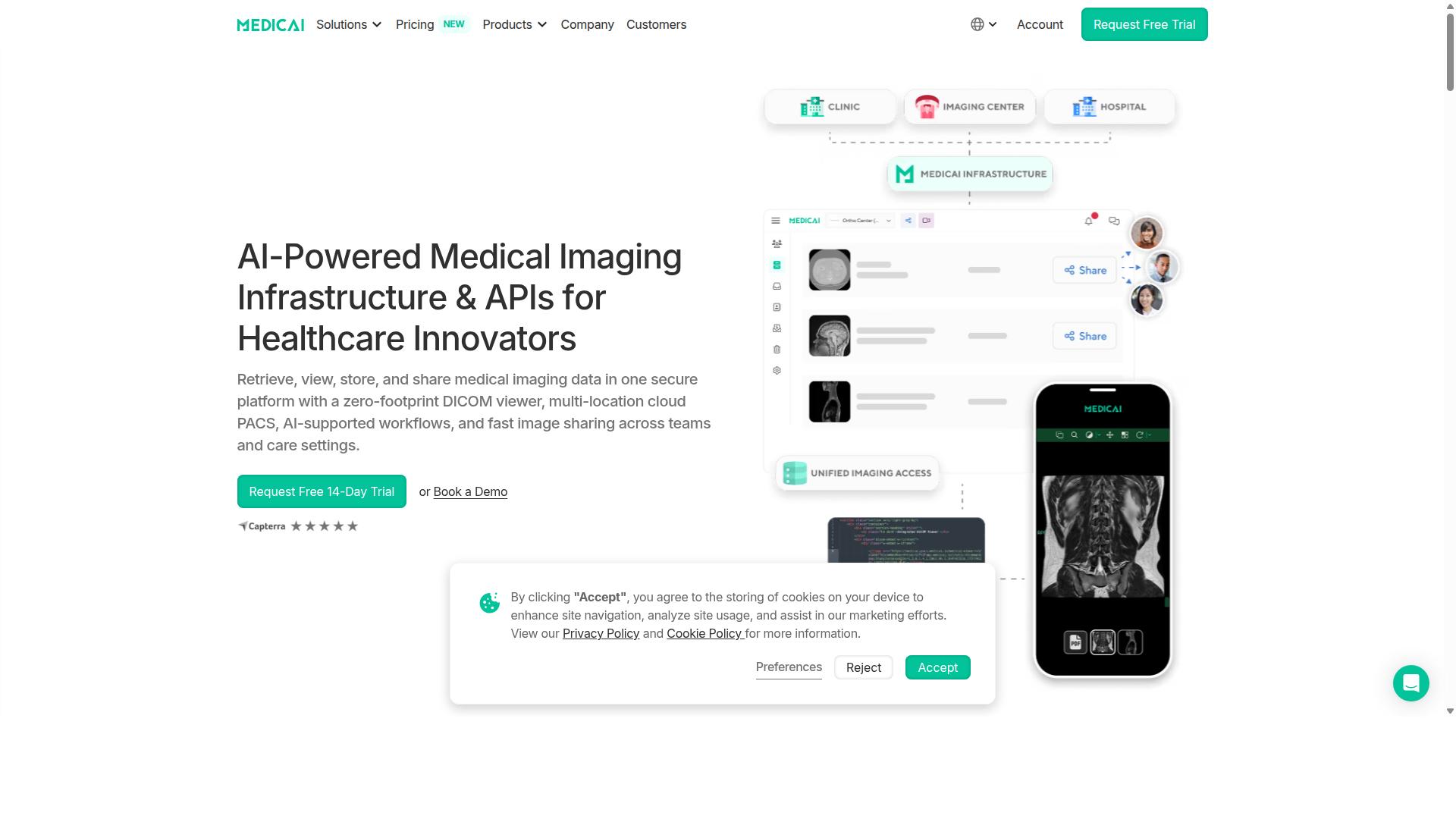
Medicai is a cloud-based medical imaging platform that consolidates retrieval, viewing, storage, and sharing of imaging studies into one secure, zero-footprint DICOM viewer.
The platform operates on a SaaS model that delivers Imaging Infrastructure as a Service. Healthcare providers access the full feature set through a web browser without installing software or managing servers. Our breakdown of MRI Cervical Spine Without Contrast CPT Code Guide covers the related details.
Its zero-footprint viewer architecture runs entirely in the browser. This design eliminates local storage requirements and reduces IT overhead for radiology teams.
Currently, 1.7 million studies reside in the distributed storage environment. The system supports continuous growth through automatic resource allocation across multiple geographic regions.
Global availability ensures consistent performance for providers working across different locations. The multi-location cloud PACS infrastructure maintains data access regardless of where care teams are located.
Why Medicai Excels at Cloud-based Scalability
Scalability in medical imaging hinges on elastic compute and resilient storage that grow with study volume and concurrent users.
Modern radiology workflows face unpredictable demand spikes that require instant resource adjustment. Elastic compute ensures that processing power scales automatically when large imaging studies arrive simultaneously.
High availability prevents workflow interruptions that delay patient care. Distributed storage keeps data accessible even during regional outages.
Multi-tenant architecture separates each clinic's data while sharing underlying infrastructure efficiently. This design reduces costs while maintaining performance during peak periods.
Multi-Location Cloud PACS Architecture
A multi-location architecture places data closer to clinicians while maintaining a single source of truth.
Load balancing distributes incoming requests across multiple data centers. Edge caching stores frequently accessed images near regional users, cutting retrieval times.
Resource pooling allows automatic scaling of storage and compute based on current demand. When study volume increases, additional capacity activates without manual intervention.
Throughput metrics track data transfer rates during busy periods. Fault tolerance ensures 24/7 radiology operations continue smoothly even when individual servers experience issues.
Zero-Footprint DICOM Viewer and API Scalability
The zero-footprint viewer and API layer deliver instant access without local installs while scaling to thousands of concurrent sessions.
Microservices separate routing, rendering, and AI inference into independent components. Each service scales individually based on its specific workload requirements.
On-demand provisioning handles sudden increases in study uploads without pre-allocated capacity. The platform processes 50 million yearly API transactions across 10,000 active doctors.
FHIR interoperability connects directly with existing EMR systems. This connection maintains workflow continuity while supporting the 1 million studies transacted annually.
Pricing and Plans
Medicai offers transparent monthly tiers that align storage and connectivity with practice size. The pricing structure supports cloud scalability by letting organizations add capacity without changing their core subscription model.
Starter plan costs $249 per month and includes 500 GB of cloud storage. Unlimited user accounts allow entire departments to access the platform without additional per-seat charges. This arrangement keeps cost-per-study predictable during early growth phases.
Standard plan costs $749 per month and includes 2 TB of cloud storage. One connected location supports DICOM gateway setup for direct imaging device integration. Practices that need more connectivity can upgrade to Enterprise for custom storage volumes and multiple external locations.
Yearly billing reduces Starter to $209 per month and Standard to $639 per month. The 15 percent savings reward organizations that commit to longer terms while maintaining the same storage and connectivity benefits.
Pay-as-you-go burst capacity lets users exceed their monthly storage allocation without moving to a higher tier. This model supports elastic compute and on-demand provisioning as medical imaging volume increases.
Unlimited user accounts and per-study pricing for Enterprise customers remove barriers that typically increase cost-per-study during rapid growth. Distributed storage and resource pooling keep expenses aligned with actual usage rather than predetermined capacity limits.
Trust Signals
Compliance and uptime certifications serve as evidence that patient data remains protected at every layer. Medicai maintains HIPAA and GDPR compliance across all workflows. These standards establish clear boundaries for how medical imaging data moves between users and systems.
The platform also holds FDA and CEE clearance for its viewers. This clearance confirms that the tools meet regulatory requirements for diagnostic use. Every certified component undergoes repeated evaluation to maintain approval status.
Encryption at rest protects stored studies while zero-trust security policies limit access privileges. These measures support measurable uptime and reduce exposure to unauthorized activity. Breach prevention becomes a direct outcome of consistent security controls.
Medicai processes over one million studies annually. This volume reflects the platform's ability to handle demand without performance loss. Regular throughput shows that scalability and security operate together.
Who Should Use Medicai
Any healthcare provider that handles diagnostic imaging studies can benefit from a unified cloud archive. Cloud-based scalability becomes essential when imaging volumes grow or fluctuate across multiple sites.
Hospitals rely on elastic compute to manage large radiology departments. Multi-tenant architecture lets them expand storage without new hardware purchases. Resource pooling ensures consistent performance during peak imaging hours.
Imaging centers need distributed storage for high patient throughput. Auto-scaling responds to daily volume changes while load balancing keeps studies accessible across locations.
Specialty clinics in orthopedics, neurology, oncology, cardiology, dentistry, and gastroenterology gain from on-demand provisioning. These departments often deal with complex studies that require rapid access and reliable backup.
Users completed 300 000 DICOM visualizations in the past year. This volume shows how high availability and fault tolerance support continuous clinical operations.
Virtual care providers and telemedicine platforms also depend on PACS integration and DICOM routing for timely image delivery. Teleradiology services use the same infrastructure to maintain workflow speed across regions.
Personal injury lawyers, tumor boards, and clinical trials require secure, centralized archives. HIPAA compliance and encryption at rest protect sensitive data while supporting collaborative review.
Medical education organizations access imaging data for training and research. Vendor-neutral archive capabilities ensure compatibility with existing systems across institutions.
Patients benefit from the Patient Portal for direct access to their studies. API-first design enables smooth connections with existing hospital systems.
Final Verdict
Medicai delivers a scalable, compliant platform that removes infrastructure overhead from radiology workflows. The system handles growing imaging volumes without manual server management through elastic compute and auto-scaling capabilities.
Cloud scalability stands out because the architecture provisions resources on demand. Medical imaging teams access storage and processing power exactly when patient volumes rise, then scale down during quieter periods.
Compliance features address healthcare regulations across different regions. HIPAA compliance and data sovereignty controls help practices meet local requirements while maintaining security standards for patient information.
Global reach comes from two established offices that support international customers directly. Medicai USA operates at 7901 4th St N, STE 300, St. Petersburg, FL, 33702 with phone access at +1 (832) 220 1035.
Medicai Romania maintains operations at 53-55 N Filipescu, 5th Floor, Sector 2, Bucharest, 020961, reachable at +40 316 305 875. Both locations serve as sales contact points for organizations evaluating the platform.
Teams considering cloud-based medical imaging solutions can reach out to either office to discuss specific scalability needs. The distributed infrastructure supports radiology practices regardless of location or size requirements.
Key Features and What Makes Medicai Stand Out
The platform's core capabilities translate directly into operational efficiency for imaging-heavy practices. Cloud scalability becomes essential when radiology departments face fluctuating study volumes throughout the day.
Multi-location storage solutions address the challenge of accessing patient images across different facilities without delays. This distributed approach keeps data available while maintaining compliance with healthcare regulations.
API scaling mechanisms handle increased demand during peak hours without manual intervention. The system automatically adjusts resources to match actual usage patterns rather than maintaining constant overcapacity.
These architecture elements work together to eliminate common bottlenecks that slow down medical imaging workflows. Practices can focus on patient care instead of managing infrastructure limitations.
Recommended Resources: