What Is the Best Vendor Neutral Archive Cloud PACS for Multi-Site Imaging in 2026?
Your radiologists are logging into four different PACS to read one patient's history. Every new imaging site adds another silo, another viewer, another contract, and the images still do not follow the patient across your network. Choosing the wrong archive in 2026 means repeating that fragmentation for years.
This article explains what to look for in a vendor neutral archive and cloud PACS built for multi-site imaging, and how Medicai combines storage, viewing, and image exchange in one platform. By the end, you will know which features matter, what pricing structures to expect, and whether Medicai fits your organization.
What Is Medicai? The Cloud Imaging Platform Behind the Answer
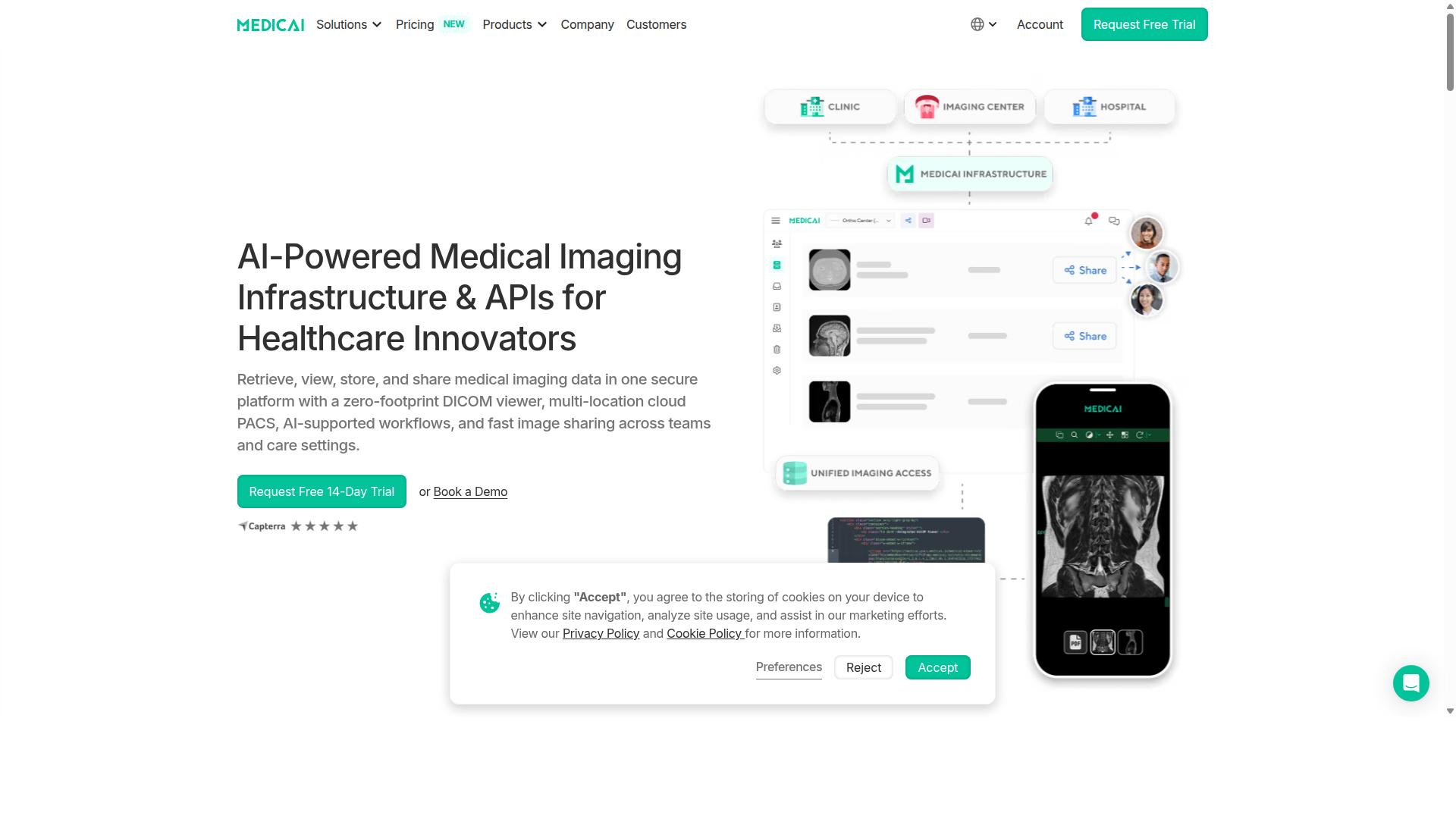
Medicai is a cloud-based medical imaging platform that unifies retrieval, viewing, storage, and sharing of medical imaging data in one secure environment. It was built to remove the friction that traditional on-premise infrastructure creates for imaging teams.
At its core sits a zero-footprint DICOM viewer, which means clinicians open studies in a browser rather than installing and maintaining desktop software. A multi-location cloud PACS handles storage and retrieval across sites, while AI-supported workflows and fast image sharing keep teams connected across care settings.
Because there is no on-premise hardware to stand up or refresh, healthcare providers can access imaging data from anywhere. That matters for multi-site imaging, where a study captured at one facility often needs to be read or reviewed at another.
Medicai delivers this as Imaging Infrastructure as a Service (IIaaS), a model that treats imaging infrastructure as a managed service rather than a capital project. The platform is VC-backed and focused on modernizing medical imaging workflows and enabling interoperability.
Standards support is central to that interoperability story. Medicai works with DICOM, HL7, and FHIR, the formats and frameworks that let imaging systems, EHRs, and other clinical tools exchange data reliably. These standards underpin the vendor neutral and cloud PACS capabilities discussed throughout this article.
Who Medicai Serves: Multi-Site Hospitals, Imaging Centers, and Specialty Care
Medicai is designed for healthcare providers that need to manage imaging across multiple locations, from large hospital networks to specialized clinics. The platform also serves virtual care providers, telemedicine platforms, and teleradiology services.
Specialty care is a major part of the audience. Medicai supports providers in orthopedics, neurology, oncology, radiology, cardiology, ophthalmology, ob-gyn, pulmonology, dentistry, and gastroenterology. Each of these fields reads and shares imaging differently, so multi-site image exchange and subspecialty reading are practical requirements rather than nice-to-haves.
Beyond clinical delivery, Medicai serves personal injury lawyers, tumor boards, clinical trials, and medical education organizations. Patients are served too, through a Patient Portal that gives them a route to their own imaging.
Consider a radiology group operating several clinics. With a cloud PACS and zero-footprint viewer, images from every site can be centralized for reading and consultation, and compliance with HIPAA and GDPR stays part of the platform's design rather than an afterthought bolted on later.
The common thread is multi-location access. Whether the setting is a hospital network, an imaging center, or a specialty practice, the goal is the same: retrieve, view, store, and share studies without being tied to one building or one workstation.
Why Medicai Is the Best Vendor Neutral Archive Cloud PACS for Multi-Site Imaging in 2026
In 2026, multi-site imaging demands a platform that combines vendor neutrality, cloud scalability, and seamless image exchange. Medicai delivers all three in a single environment trusted by 70 clinics and hospitals and more than 10,000 active doctors.
The old model of separate systems for archiving, reading, and sharing is fading. Health systems now expect one medical imaging cloud that covers the full image lifecycle, from acquisition to long-term storage to cross-site collaboration. Medicai was built around that expectation rather than retrofitted to it.
Three shifts define enterprise imaging this year. First, cloud-native architectures are replacing on-premise server rooms, because multi-site networks cannot keep pace with data growth on local hardware. Second, standards-based interoperability is no longer optional. DICOM, HL7, and FHIR form the connective tissue of any serious health information exchange, and platforms that treat them as an afterthought create new silos instead of removing old ones.
Third, AI is moving from pilot projects into daily radiology informatics. A vendor neutral archive that stores clean, standardized, longitudinal data becomes the foundation for AI-Powered Diagnostics and a Radiology AI Co-Pilot, while fragmented archives starve those tools of usable input.
Medicai answers these shifts with a unified platform. It holds 1.7M+ studies in storage and processes 1M+ studies per year, with 2M+ imaging studies uploaded to date. It is HIPAA and GDPR compliant, follows OWASP security guidelines, and runs on a Microsoft Azure partnership. For a network weighing VNA and Cloud PACS options in 2026, that combination of scale, compliance, and vendor neutrality is the strategic advantage that matters.
Vendor Neutral Archive, Cloud PACS, and Image Exchange in One Platform
Medicai merges VNA, Cloud PACS, and image exchange into a single platform, eliminating data silos and enabling seamless multi-site collaboration. Instead of stitching together a legacy archive, a reading system, and a separate sharing tool, imaging teams work from one medical imaging cloud.
Each layer has a clear role:
- Vendor Neutral Archive: long-term storage of studies in standard formats, independent of any scanner or PACS vendor, so data stays portable across the enterprise.
- Cloud PACS: primary interpretation for radiologists, supported by a DICOM Viewer, Structured Reporting for Radiology, and teleradiology workflows.
- Image Exchange: sharing studies and cases across sites through the Medical Image Exchange and Patient Case Management tools, plus a Doctor Imaging Portal and Patient Imaging Portal.
Standards-based interoperability ties it together. Medicai supports DICOM, HL7, and FHIR. That means EHR and EMR integration, RIS connectivity, modality worklist support, and participation in a health information exchange without custom one-off connectors for every site.
Consider a hospital network that reads at a central hub and shares studies with affiliated clinics. With Medicai, a study acquired at a remote site flows into the VNA, appears for interpretation in the Cloud PACS, and can be exchanged with an affiliated clinic or an external specialist in the same environment. The platform handles 50M+ yearly API transactions and 300k+ visualizations of DICOM studies in the last year, which reflects that kind of daily, multi-site load.
The strategic payoff is reduced IT overhead, since there is no server fleet to maintain per location, and simpler scalability as new sites join. Clinical workflows improve too: Medicai reduces diagnosis time by 65%, and its FDA/CEE Cleared Viewers give radiologists and referring physicians confidence in what they see. For a network planning a legacy PACS migration or replacing a patchwork of archives, one platform means one data migration, one image lifecycle management model, and one place where vendor neutrality is guaranteed by design.
Key Features That Set Medicai Apart for Multi-Site Imaging
Medicai's feature set addresses the entire imaging lifecycle, from data ingestion to visualization and collaboration, with tools built for multi-site efficiency. Instead of forcing radiology teams to stitch together separate systems for each location, the platform organizes capabilities into three connected categories that map to how enterprise imaging actually works.
These categories are Connect & Retrieve, Store & Manage, and Access, Visualize, Collaborate. Each one targets a specific pain point that multi-site organizations face: pulling data in from scattered sources, keeping it secure and available over the long term, and getting it into the hands of the people who need to see it.
Multi-site imaging is difficult for structural reasons. A hospital group may run different PACS vendors at each campus, hold decades of studies in legacy archives, and need images to move between sites without manual exports or duplicate storage. Standards-based interoperability through DICOM and HL7 is what makes that movement possible, and it is central to how Medicai approaches image exchange.
Data migration and legacy PACS integration are often the first real tests of any Vendor Neutral Archive or Cloud PACS deployment. A platform that cannot absorb what a site already has, or connect to the systems already in use, creates more work than it removes. Medicai's tools are designed around that reality.
The three subsections that follow break down each feature category in turn. They cover what the tools do, how they fit multi-site workflows, and where they make a measurable difference for imaging teams managing studies across more than one location.
Connect & Retrieve: DICOM Gateway and Medical Imaging Uploader
Medicai's Connect & Retrieve tools, including a DICOM Gateway and Medical Imaging Uploader, simplify the ingestion of imaging data from any source. The DICOM Gateway connects to modalities, PACS, and VNAs, supporting both DICOM and HL7 so that imaging and administrative data can flow into one environment.
The Medical Imaging Uploader handles manual and automated uploads. That flexibility matters when a site needs to bring in a batch of prior studies, onboard a new location, or accept images from an outside facility that is not yet connected through a gateway.
For multi-site organizations, these tools address three common scenarios:
- Legacy PACS migration: moving historical studies out of aging on-premise systems and into a cloud environment without losing metadata or study integrity.
- EHR and EMR integration: linking imaging to the patient record so clinicians can reach studies from the systems they already use.
- Multi-site data handling: consolidating imaging from several campuses into one accessible archive rather than maintaining separate silos.
Support for Modality Worklist and DICOMweb keeps the platform aligned with modern interoperability standards. That matters for health information exchange and for any organization planning around IHE and XDS-I profiles.
A concrete example shows the scale involved. A hospital connecting 10 modalities across three sites can route every study through a single gateway instead of managing three separate integrations. Medicai reports 2M+ imaging studies uploaded and 50M+ yearly API transactions, which reflects the volume this kind of ingestion layer is built to handle.
Store & Manage: Cloud PACS, VNA, and Backup and Disaster Recovery
Medicai's Store & Manage capabilities provide scalable cloud storage, a vendor neutral archive, and robust backup and disaster recovery. Together these cover the full image lifecycle, from active reading to long-term retention and business continuity.
The Cloud PACS supports primary reading, giving radiologists a working environment for day-to-day diagnostic interpretation. The Vendor Neutral Archive handles long-term archiving in a format that is not tied to any single PACS vendor, which is exactly what multi-site organizations need when they run mixed systems or plan to change vendors later.
Backup and Disaster Recovery rounds out the category by protecting continuity. If a site loses local access, the archive and its copies remain available through the cloud rather than depending on one physical location.
Storage scales with demand. An organization might begin with 500 GB and grow into multi-terabyte volumes as more sites and more years of studies are added. Medicai currently holds 1.7M+ studies in storage, and the platform is HIPAA and GDPR compliant, with OWASP security guidelines followed across its environment.
Centralized storage changes how multi-site groups operate. Instead of each campus maintaining its own archive and its own retention policy, imaging data lives in one managed environment with consistent rules. Medicai's Microsoft Azure partnership supports that cloud foundation.
The practical benefit is straightforward. A single archive reduces duplication, simplifies image lifecycle management, and gives every site access to the same body of studies. For a growing enterprise imaging program, that centralization is often the difference between a manageable archive and a fragmented one.
Access, Visualize, Collaborate: Zero-Footprint DICOM Viewer and Structured Reporting
Medicai's zero-footprint DICOM viewer and structured reporting tools enable secure access, visualization, and collaboration from any web browser. Because the viewer runs in the browser, there is no workstation software to install at each site, which removes a common barrier in multi-site deployments.
The viewer delivers diagnostic-quality images with tools for reviewing and annotating studies. Radiologists can review cases from a hospital, an office, or home without sacrificing the functions they rely on for interpretation. Medicai's viewers are FDA/CEE cleared, and the platform reports 300k+ visualizations of DICOM studies in the last year.
Structured Reporting for Radiology supports clearer communication between radiologists and referring physicians. Standardized report formats reduce ambiguity and make findings easier to act on, which matters when care teams are spread across locations.
Collaboration features extend the same environment to shared decision-making:
- Case sharing between clinicians at different sites
- Support for tumor boards and multidisciplinary conferences
Consider a radiologist reviewing a study from home and sharing findings with a surgeon at another campus. The images, the report, and the conversation stay in one place rather than moving through email or physical media. Medicai has been featured in press for enabling global multidisciplinary tumor boards, and the platform reports reducing diagnosis time by 65%.
With 70 clinics and hospitals and 10,000+ active doctors on the platform, these tools are already in daily use across distributed care teams. For multi-site imaging in 2026, that combination of browser-based access, cleared diagnostic viewing, and built-in collaboration is what makes a Vendor Neutral Archive and Cloud PACS genuinely usable rather than just stored.
AI-Supported Workflows and Fast, Secure Image Sharing Across Sites
Medicai integrates AI-supported workflows and secure image sharing to accelerate diagnosis and improve care coordination across multiple sites. Rather than building every algorithm in-house, Medicai connects its platform to specialized AI partners and exposes APIs that let imaging organizations plug in the tools that fit their clinical needs.
This approach matters for multi-site groups because AI value depends on data reaching the algorithm quickly and results returning to the reading workflow. When studies live in one accessible archive instead of scattered local servers, every site can benefit from the same AI capabilities without duplicating infrastructure.
Medicai's partner ecosystem includes MD.ai and Rayscape.ai, alongside FlexView, OHIF, MedDream, and Meditice. These partnerships and integration APIs mean a radiology network can adopt AI-assisted detection, triage, or review tools without abandoning its existing viewer or archive strategy.
For enterprise imaging teams evaluating a Vendor Neutral Archive in 2026, this openness is a core requirement. A cloud PACS that locks AI behind a single vendor limits future options. An API-driven model keeps the door open as algorithms mature and clinical evidence accumulates.
Secure sharing is the second half of the equation. Medicai supports sharing DICOM studies through links with expiration options and access controls, so a referring physician, specialist, or tumor board member sees exactly what they need, for as long as they need it.
For multi-site organizations, that translates into practical gains: faster referrals between locations, quicker second opinions, and smoother tumor board preparation. Instead of burning CDs or chasing VPN access, clinicians share a controlled link and move on to the diagnosis.
Compliance and audit trails underpin the whole process. Access controls and link expiration support governance requirements, while audit trails give imaging leaders visibility into who viewed which study and when. That is essential for HIPAA-aligned operations and for internal quality review.
Scale is not theoretical here. Medicai has supported 300k+ visualizations of DICOM studies in the last year, evidence that the sharing and AI-integration model holds up under real clinical volume across distributed sites.
- AI partnerships including MD.ai and Rayscape.ai, with APIs for further integration
- Secure study sharing via links with expiration and access controls
- Audit trails and compliance support for multi-site governance
- 300k+ DICOM study visualizations in the last year
The verdict for multi-site imaging in 2026 is straightforward: AI only pays off when images move freely and safely between sites. Medicai pairs an open AI ecosystem with controlled, auditable sharing, making it a strong choice for organizations that need both innovation and governance from their cloud PACS.
Pricing and Plans for Multi-Site Organizations
Medicai offers transparent, scalable pricing plans designed for multi-site organizations, with options for storage capacity and connected locations. For imaging groups weighing a Vendor Neutral Archive or Cloud PACS in 2026, predictable costs matter as much as clinical capability. Medicai keeps its structure simple, so budgeting for Multi-Site Imaging does not require decoding a maze of usage fees.
Two published plans anchor the entry points, and both include unlimited user accounts. That matters for radiology groups where technologists, radiologists, and referring clinicians all need access to a Diagnostic Viewer without per-seat charges.
| Plan | Monthly Price | Cloud Storage | Connected Locations | User Accounts |
|---|---|---|---|---|
| Starter | $249/month | 500 GB | None | Unlimited |
| Standard | $749/month | 2 TB | One connected location | Unlimited |
| Enterprise | Custom pricing | Custom | Multiple connected and external locations | Unlimited |
Yearly billing lowers the effective rate by 15 percent. On an annual commitment, Starter comes to $209/month and Standard to $639/month. A free 14-day trial of Starter plan features is included, with no credit card required to begin.
Two other costs are worth planning for. A DICOM Gateway Setup runs $1,000 one-time per location, which covers the connection point that feeds studies into the archive. Enterprise customers can also choose per-study pricing instead of a flat subscription. Refunds are not available for partial periods, so align billing cycles with your fiscal calendar.
Scaling follows a clear path. A single-site practice can start on Standard, then add connected locations and storage as the network grows. Enterprise pricing handles multiple connected locations alongside multiple external locations, which suits groups exchanging images with partner facilities through standards-based interoperability. Because the platform is a Medical Imaging Cloud service, there is no server hardware to buy, no data center to maintain, and no annual refresh cycle to fund. For a three-site imaging center, the practical route is Standard at $749/month for the first connected location, then Enterprise terms to bring the remaining sites and any external partners onto one Image Lifecycle Management footprint.
Trust Signals: Compliance, Scale, and Clinical Validation
Medicai demonstrates trust through rigorous compliance, proven scale, and clinical validation from industry leaders. For multi-site imaging organizations evaluating a Vendor Neutral Archive or Cloud PACS in 2026, these signals matter because they directly reduce operational and regulatory risk.
When a health system consolidates imaging across dozens of facilities, a single compliance gap or platform failure can affect every site at once. That is why verified credentials and real-world volume should sit at the top of any vendor checklist.
Compliance and security. Medicai is HIPAA and GDPR compliant, with FDA and CEE Cleared Viewers available for diagnostic and clinical use. The platform also follows OWASP security guidelines, a recognized framework for protecting web applications against common vulnerabilities.
For multi-site organizations operating across jurisdictions, HIPAA and GDPR coverage matters on both sides of the Atlantic. A Vendor Neutral Archive holding patient studies must meet strict privacy rules wherever those patients receive care.
Cloud infrastructure partnerships. Medicai works with Microsoft Azure, giving multi-site imaging operations a foundation built on enterprise-grade cloud storage and networking. This aligns with the broader shift toward Medical Imaging Cloud and Hybrid Cloud PACS models that reduce on-premise hardware burdens.
Scale that reflects real production use. Platform metrics show meaningful adoption across the imaging ecosystem:
- 1M+ studies transacted or processed per year
- 1.7M+ studies in storage
- 2M+ imaging studies uploaded
- 50M+ yearly API transactions
- 300k+ visualizations of DICOM studies in the last year
- 70 clinics and hospitals on the platform
- 10,000+ active doctors on the platform
These numbers matter for multi-site imaging because they show the platform handles high-volume DICOM traffic and API-driven interoperability at scale. Fifty million yearly API transactions, for example, points to deep integration activity, the kind required for EHR Integration, RIS connectivity, and standards-based data exchange.
Medicai also reports reducing diagnosis time by 65%, a metric that speaks directly to clinical workflow impact rather than infrastructure alone.
Clinical validation and advisory leadership. Trust in radiology informatics is not only technical. It also comes from the clinicians and institutions that stand behind a platform.
Medicai's advisory board includes J. Michael Kramer, MD, bringing physician-level perspective to product direction. The company has also partnered with Boehringer Ingelheim, a relationship that signals confidence from a major life sciences organization.
Medicai has been featured in press for enabling global multidisciplinary tumor boards and for helping Ukrainian refugee patients access cancer treatments. These examples show the platform supporting real clinical scenarios, not just storage and retrieval.
Why these signals reduce risk. For a multi-site organization, vendor selection is a long-term commitment. Imaging archives hold years of patient data, and migration between platforms is costly and disruptive.
Compliance certifications lower legal exposure. FDA and CEE cleared viewers support diagnostic confidence. Cloud partnerships with providers like Microsoft Azure reduce infrastructure uncertainty. Documented scale shows the system has been tested by real clinical demand.
Clinical validation through advisory leadership and institutional partnerships adds another layer. Together, these factors help multi-site imaging leaders choose a Vendor Neutral Archive and Cloud PACS with verifiable credentials rather than unproven claims.
In 2026, as Enterprise Imaging strategies mature and standards like DICOM, HL7, and FHIR shape interoperability expectations, trust signals become a practical filter. Medicai's compliance posture, production scale, and clinical relationships position it as a credible option for organizations managing imaging across many sites.
Who Should Use Medicai
Medicai is ideal for healthcare organizations that need to unify imaging across multiple sites, from hospitals to specialty clinics. Its SaaS model fits any provider that wants a Vendor Neutral Archive and Cloud PACS without managing on-site infrastructure. Because it is available globally, geography is rarely a barrier.
The platform serves hospitals, imaging centers, and specialty care providers across a wide range of clinical fields. That breadth matters for multi-site imaging, where a single network may need to store and share DICOM studies from very different departments.
- Orthopedics, neurology, and oncology
- Radiology, cardiology, and pulmonology
- Ophthalmology, ob-gyn, dentistry, and gastroenterology
For these groups, the value is straightforward: one place to manage image lifecycle, support standards-based interoperability, and give clinicians fast access to prior studies. A neurology team reviewing follow-up scans and an oncology service tracking treatment response both benefit from the same unified archive.
Multi-site hospital networks with affiliated clinics are a natural fit. When a main hospital and its satellite sites run separate systems, images get stranded. Medicai helps consolidate that imaging so a specialist at one location can review a study captured at another, supporting Enterprise Imaging goals without a heavy on-premise footprint.
Teleradiology groups also match well. These services depend on reading studies remotely and routing them to the right radiologist quickly. A cloud-based archive and diagnostic viewer reduce the friction of moving images between sites and reading locations.
Research institutions and clinical trials have distinct needs. They often handle imaging across multiple sites and require consistent, organized access to studies. Medicai's support for tumor boards, clinical trials, and medical education organizations reflects these collaborative, multi-party workflows.
Other profiles round out the picture. Virtual care providers and telemedicine platforms can connect imaging to remote consultations. Personal injury lawyers use medical imaging to review and organize records for cases. Medical education organizations rely on imaging for teaching.
Patients are served too, through the Patient Portal, which gives individuals a way to access their own imaging. That closes the loop for organizations that want patients to be part of the care journey rather than locked out of their own records.
The common thread across every profile is scale and variety. If an organization stores imaging in more than one place, treats more than one specialty, or coordinates care across locations, Medicai is built for that reality. A single-site practice with no sharing needs is not the target audience. Multi-site imaging, by contrast, is exactly the problem Medicai is designed to solve.
Final Verdict
Medicai stands out as a comprehensive, scalable, and compliant cloud imaging platform for multi-site organizations in 2026. For imaging groups weighing a Vendor Neutral Archive against a Cloud PACS, Medicai removes the need to choose between them by combining both in one platform.
That combination matters most where multi-site imaging gets complicated: scattered legacy archives, mixed modality vendors, and referring physicians who need fast access from any browser. A unified VNA and Cloud PACS keeps studies in one standards-based layer instead of duplicating storage and workflows site by site.
Strengths that hold up
- Unified VNA and Cloud PACS: one platform for long-term image lifecycle management and day-to-day radiology reading, rather than two disconnected systems.
- Zero-footprint viewer: a browser-based diagnostic and clinical viewer that avoids workstation installs across multiple locations.
- Standards-based interoperability: support for DICOM, HL7, and FHIR keeps image exchange, HIE, and EHR or EMR integration practical.
- Transparent pricing: buyers can evaluate cost against value without the opacity common in enterprise imaging contracts.
- Strong compliance posture: a meaningful requirement for any organization handling patient imaging data across sites and regions.
These strengths line up with what multi-site imaging teams actually need in 2026: fewer point solutions, predictable costs, and access that does not depend on a specific desk or device.
Where to weigh trade-offs
No platform fits every environment out of the box. Organizations with highly specific reporting templates, unusual subspecialty workflows, or deep ties to a particular RIS may need configuration work during rollout. That is normal for enterprise imaging and not a reason to rule Medicai out.
The honest framing is this: customization is a planning item, not a dealbreaker. Teams that map their modality worklist, DICOMweb, and legacy PACS migration requirements early tend to move through implementation with fewer surprises.
Overall value
For multi-site groups, the value case rests on consolidation. One platform covering VNA, Cloud PACS, a universal viewer, and standards-based interoperability reduces the operational drag of running separate archives and viewers per site.
Add transparent pricing and a strong compliance foundation, and Medicai becomes a credible long-term choice rather than a short-term fix. Consolidation is where most imaging organizations find their biggest efficiency gains, and Medicai is built around exactly that idea.
Next step
If your organization is evaluating a VNA or Cloud PACS for multi-site imaging, the fastest way to judge fit is a walkthrough against your own workflows. Reach the Medicai team directly to discuss your requirements or request a demo.
- Medicai USA: 7901 4th St N, STE 300, St. Petersburg, FL, 33702. Phone: +1 (832) 220 1035
- Medicai Romania: 53-55 N Filipescu, 5th Floor, Sector 2, Bucharest, 020961. Phone: +40 316 305 875
- Email: [email protected]
For multi-site imaging in 2026, Medicai earns a clear recommendation: unified architecture, browser-based access, transparent pricing, and a compliance-first design make it a strong foundation for enterprise imaging.
Frequently Asked Questions
What makes a vendor neutral archive "cloud PACS" different from a traditional PACS?
A traditional PACS is typically tied to one imaging vendor and often one site, which makes multi-site image sharing painful. A vendor neutral archive stores DICOM studies in a standard, vendor-independent format, and a cloud PACS adds web-based access on top of that archive. Medicai combines both in one platform: a Vendor Neutral Archive for storage and a zero-footprint DICOM viewer for retrieval, viewing, and sharing across locations.
Can Medicai handle imaging data from multiple sites and locations?
Yes. Medicai is built as a multi-location cloud platform, so healthcare providers can retrieve, view, store, and share imaging data from different sites in one secure environment. Its Connect & Retrieve tools include a Medical Imaging Uploader and a DICOM Gateway for bringing studies in, while Cloud PACS and Medical Image Exchange handle storage and cross-site access. For organizations with more than one connected location, the Enterprise plan is the relevant tier.
How is Medicai priced for a multi-site imaging setup?
Medicai uses monthly billing with published tiers: Starter at $249/month (500 GB cloud storage, unlimited user accounts, no connected locations), Standard at $749/month (2 TB cloud storage, unlimited user accounts, one connected location), and Enterprise with custom pricing. Because multi-site imaging usually means more than one connected location, Enterprise is typically the right conversation. You can request a quote through [email protected].
Is Medicai secure and compliant enough for clinical imaging across sites?
Medicai is HIPAA and GDPR compliant and offers FDA/CEE cleared viewers, which matters when imaging is shared beyond a single facility. The platform is also built with OWASP security practices in mind. For multi-site providers, that combination supports both regulatory requirements and the practical need to move studies securely between locations.
What kind of organizations use Medicai for multi-site imaging?
Medicai serves healthcare providers including hospitals, imaging centers, and specialty care providers such as orthopedics, neurology, oncology, radiology, cardiology, ophthalmology, ob-gyn, pulmonology, dentistry, and gastroenterology, as well as virtual care organizations. If your workflow involves studies originating at more than one site, the platform's Cloud PACS, Vendor Neutral Archive, and Medical Image Exchange are designed for exactly that scenario.
Does Medicai replace our existing PACS, or work alongside it?
Medicai can function as a cloud PACS and Vendor Neutral Archive in its own right, and it also supports Backup and Disaster Recovery for imaging data. That means it can serve as your primary imaging platform or as a neutral layer that consolidates and protects studies across sites. To determine the best fit for your existing infrastructure, it's worth speaking with the Medicai team directly.
Recommended Resources: